BUILDING AI-READY ORGANIZATIONS
AI Transformation
Readiness, enterprise strategy, target operating models, responsible AI governance, priority use cases, and value realization.
Explore the transformation domain →
ARRC AI helps organizations move beyond isolated pilots and fragmented technology investments toward an enterprise model where people, processes, data, and intelligent systems create measurable performance improvement.
AI value is created when institutions redesign decisions, work, capability, and technology governance together.
Readiness, enterprise strategy, target operating models, responsible AI governance, priority use cases, and value realization.
Explore the transformation domain →Executive leadership, manager enablement, workforce-wide adoption, specialist academies, applied innovation, and continuous learning.
Explore human enablement →Knowledge assistants, agent systems, intelligent workflows, governed data platforms, decision intelligence, vision, and sector solutions.
Explore solutions and products →A single accountable structure connects transformation design, capability building, product delivery, governance, and scale.
Organizations do not scale AI by adding more tools. They scale it by aligning strategy, operating models, governance, people, workflows, data, and value.
Structures, reporting lines, governance forums, decision rights, role clarity, oversight, risk, and escalation.
AI literacy, capability profiles, human–AI collaboration, change, adoption, trust, and confidence.
Core workflows, hand-offs, approval paths, data flow, decision-making, and operational integration.
Knowledge access, performance tracking, scenario simulation, value measurement, and continuous optimization.
A fast-moving field requires practitioner-led learning, live research, role-specific pathways, recognized credentials, and applied outputs.
Strategic direction, governance, investment priorities, leadership alignment, and organizational readiness.
Role-specific technical capability, production methods, labs, tools, and professional certification preparation.
Safe, productive use of AI across functions, with practical literacy, workflow application, and responsible behavior.
Challenges, internal venture programmes, prototypes, use-case portfolios, governance packs, and implementation plans.
Research-refresh cycles, role-aligned pathways, recognized credentials, sustained communities, and measurable value.
A trusted AI product is built on governed data, embedded in real workflows, assigned to a named owner, secured by design, and explainable in every consequential output.
Arabic-first enterprise assistants, specialist agent crews, retrieval over institutional knowledge, and human approval for consequential actions.
AI-enabled process automation, document intelligence, smart intake, routing, triage, quality control, and redesigned hand-offs.
Data unification, reconciliation, quality scoring, lineage, audit trails, analytics environments, and sovereign secure deployment—cloud or on-premise.
Executive cockpits, indicator intelligence, forecasting, early warning, scenario simulation, computer vision, geospatial analytics, and smart operations.
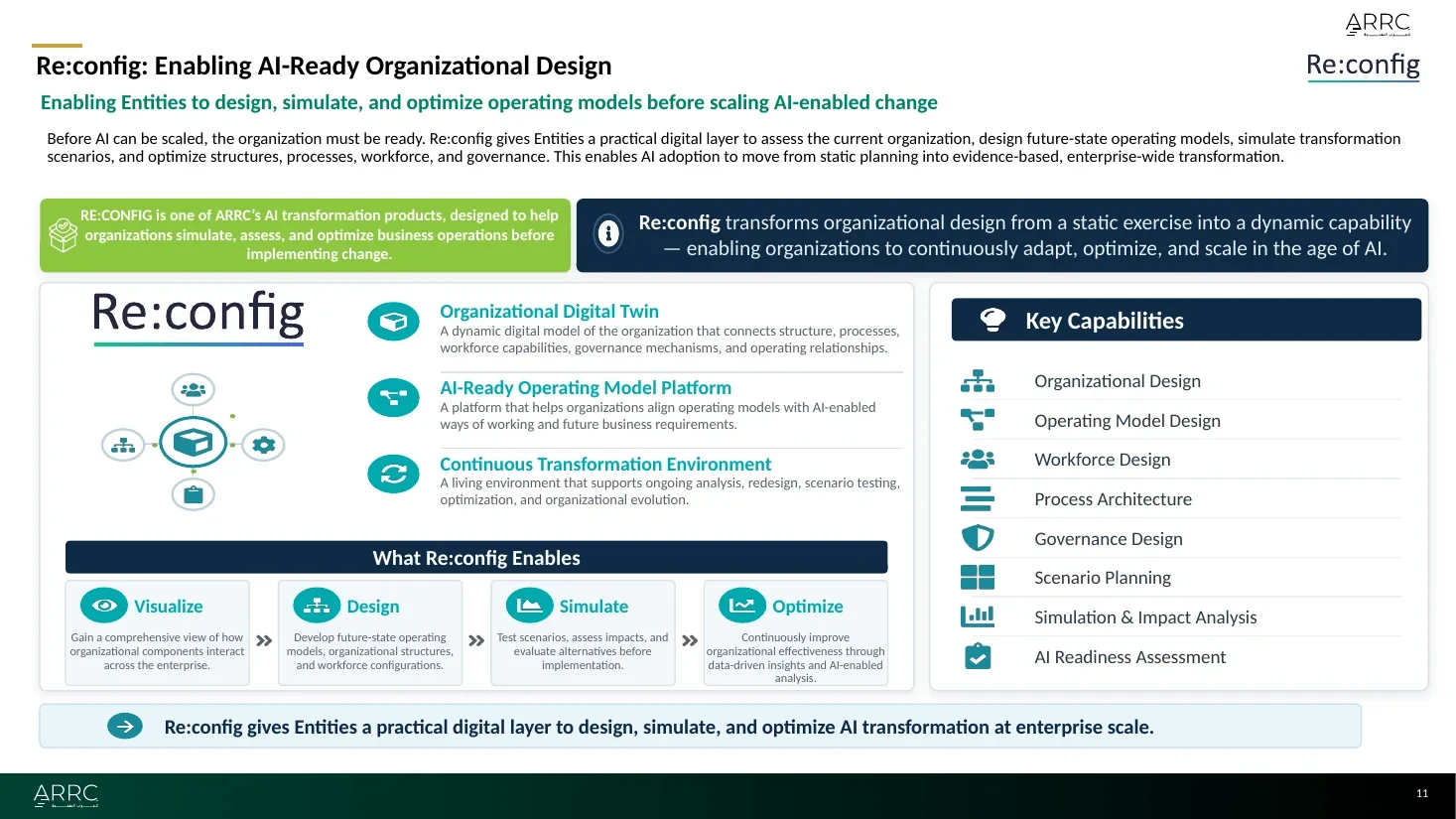
A working ARRC AI product that enables organizations to visualize, design, simulate, and optimize AI-ready operating models before change is implemented.
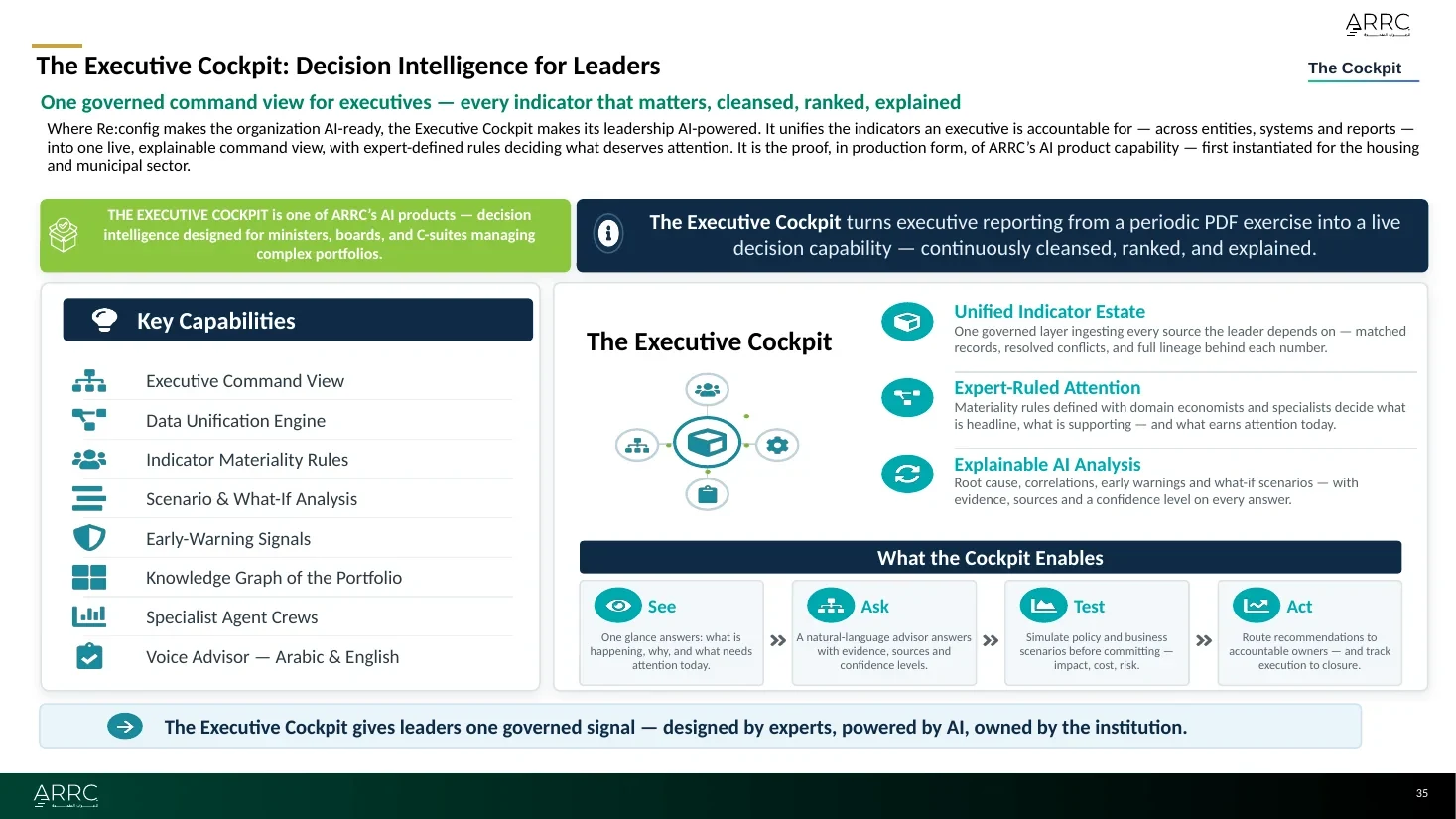
A governed command view that unifies indicators, ranks attention, explains signals, tests scenarios, and routes accountable action across complex leadership portfolios.

An intelligent institutional-memory experience that turns governed documents, decisions, and evidence into trusted answers, analyses, and ready-to-use outputs.
Every solution begins with the decision it must serve, is built on governed data, integrated into real workflows with security and human controls, and transferred as a capability the client can operate.
Decision, use case, data access, architecture, security blueprint, value case, and success metrics.
Governed data foundation, model and agent build, interface design, and validation with client experts.
System integration, SSO, access controls, human-in-the-loop, audit trails, security hardening, UAT, and performance testing.
Monitoring, retraining, cost management, adoption, value tracking, capability transfer, and adjacent use-case scale.
Choose a concise executive brief, the complete presentation, structured discovery, or a bilingual assistant grounded in the public profile.
Define the decision, prove the value, build the capability, and create a repeatable model for responsible scale.